
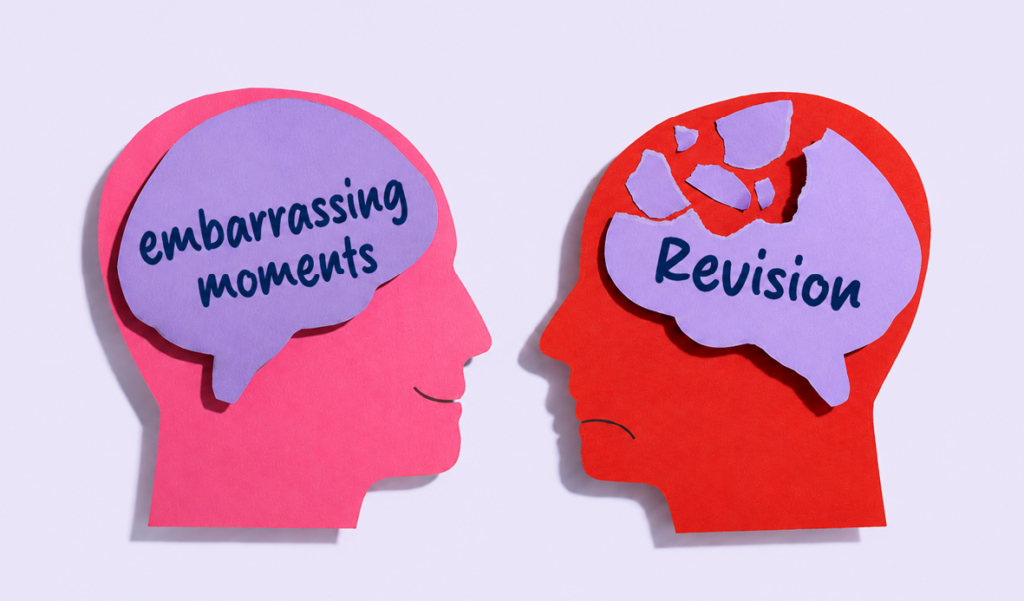
A humorous look at revision, memory, exam stress, and why your brain remembers awkward moments more easily than accounting formulas
If you can still vividly remember tripping over in Year 8 assembly, accidentally calling a teacher “mum”, or waving back at someone who definitely was not waving at you, congratulations. Your brain is working perfectly.
Unfortunately, the same brain that can preserve a social disaster from 2009 in crystal-clear detail often refuses to remember revision notes five minutes before an exam.
You spend weeks revising accounting formulas, tax rules, and depreciation methods, only to sit in the exam hall staring at the paper like you have never seen a spreadsheet before in your life.
So why does this happen? Why does your brain store embarrassing moments forever, but seem determined to delete useful revision at the worst possible moment?
The answer lies in a mixture of psychology, biology, stress, and possibly the fact that your brain enjoys being dramatic.
Why embarrassing memories stick forever
Embarrassing moments tend to create emotional reactions. Your brain loves emotional reactions.
When something awkward happens, your brain releases stress hormones like adrenaline. This tells your brain: “Important event detected. Save this forever.”
Sadly, your brain does not care whether the memory is useful. It simply notices strong emotion and stores the moment more deeply.
That is why many people can remember:
- A humiliating classroom moment from secondary school
- The exact wording of an awkward text message
- Falling over in public
- Saying “you too” when a waiter says “enjoy your meal”
But struggle to remember:
- Accruals
- Double-entry bookkeeping
- Tax percentages
- Revision notes from yesterday evening
The brain prioritises emotion over practicality. Evolution was more concerned with helping humans survive danger than remembering accounting terminology.
You can learn more about how memory works from the British Psychological Society.
The mystery of “exam panic blanking”
Almost every student has experienced it.
You walk into an exam feeling reasonably prepared after hours of revision. Then suddenly:
- Your mind goes blank
- Your confidence disappears
- You forget information you knew perfectly the night before
This is often called “exam panic blanking”, and it is surprisingly common.
When you become stressed, your body activates its fight-or-flight response. Your brain thinks something dangerous is happening, even though the “danger” is usually a Level 3 exam paper and a suspiciously squeaky chair.
Stress hormones such as cortisol and adrenaline increase. While small amounts of stress can improve focus, too much stress interferes with memory retrieval.
In simple terms, your brain temporarily struggles to access information it already knows.
It is a bit like having files saved on a computer but suddenly forgetting where the folder is.
Research from Harvard Health Publishing explains how stress can affect memory and concentration, particularly during revision and high-pressure exam situations.
The good news is that blanking does not necessarily mean your revision has failed. Often, once you calm down slightly, the information starts returning.
Usually around ten minutes after the exam finishes.
Can chewing gum actually help revision?
This debate has existed for years.
Some students swear chewing gum improves concentration during revision. Others think it is complete nonsense.
Surprisingly, there is some evidence that chewing gum may slightly improve alertness and concentration in certain situations. Scientists believe the chewing action may increase blood flow to the brain and help people stay awake and focused during revision sessions.
However, the effect appears fairly small. Unfortunately, mint gum alone will not magically help anyone understand budgeting variance calculations.
One popular theory suggests chewing the same flavour gum while revising and during the exam may trigger memory association. This is linked to “context-dependent memory”, where the brain recalls information better when conditions match the original learning environment.
Does it work perfectly? Not always.
Does it give students an excuse to buy industrial quantities of chewing gum before revision season? Absolutely.
The BBC Future has explored the science behind chewing gum and concentration in several articles.
Why students suddenly become cleaning experts during revision
Revision season creates a fascinating psychological phenomenon.
Students who have ignored laundry for three weeks suddenly decide:
- Their room must be reorganised immediately
- Every drawer needs sorting
- The kitchen requires deep cleaning
- Colour-coding stationery is essential for successful revision
This is procrastination disguised as productivity.
Psychologists sometimes call this “structured procrastination”. You avoid the difficult task by completing other useful tasks instead.
Cleaning gives quick rewards. Revision often does not.
When revising, progress can feel slow and uncomfortable. Your brain has to concentrate, struggle, and retain information over time.
Cleaning, however, provides immediate visible results. You wipe a surface and instantly feel productive.
Unfortunately, no student has ever walked into an exam and gained extra marks because their sock drawer was beautifully organised.
Although it probably felt helpful at the time.
If you are struggling to stay motivated during revision, our study resources include helpful guidance, support, and revision tools for accountancy students.
Do people really learn better with lo-fi music?
Lo-fi study playlists have become hugely popular online. Millions of students revise while listening to relaxing beats, soft jazz loops, and music that sounds like it belongs in a rainy café at 11pm.
But does it actually help revision?
The answer depends on the person.
For some students, background music helps block distractions and creates a calmer revision environment. This may improve concentration, particularly during repetitive revision tasks.
Others find any music distracting, especially if it contains lyrics.
Research generally suggests instrumental music is less disruptive than songs with words because language-processing parts of the brain are less affected.
The biggest benefit of lo-fi music may actually be routine and consistency. If listening to certain music helps you settle into revision mode, your brain begins associating that sound with concentration and focus.
In other words, the music itself may not make you smarter, but it can help create better revision habits.
Of course, there is always one student revising tax law while listening to heavy metal at maximum volume and somehow still achieving distinction grades.
Brains are strange.
You can find more research into concentration and study habits on Psychology Today.
Final thoughts
Revision is rarely straightforward. One minute you are confidently working through accounting formulas, and the next you are suddenly reorganising your desk, listening to lo-fi music, or remembering something embarrassing from secondary school instead of your revision notes.
The important thing to remember is that revision looks different for everyone. Some students prefer quiet study sessions, others work better with background music, colour-coded notes, or structured revision plans. Understanding how your brain responds to stress, memory, and concentration can make exam preparation feel far more manageable.
At Accountancy Learning, we support students throughout their revision journey with flexible distance learning courses, tutor support, study resources, and tools designed to help you feel more confident before exam day.
If you would like to discuss your study options, revision support, or finding the right course for your goals, please get in touch with our friendly team.
Call us on 01392 435349 or email [email protected]