Why distance learning can be a more flexible way to study AAT and bookkeeping
For a lot of people, studying at college feels like the “normal” route.
You pick a course, attend classes each week, follow a timetable, and work through the syllabus alongside everyone else.
And for some learners, that structure works really well.
But here’s the honest question:
Is it actually the right fit for everyone?
When it comes to studying AAT or bookkeeping, the answer is… probably not.
Because while college can suit some learners perfectly, it can also create unnecessary pressure for others — especially those trying to fit study around work, family, or just real life in general.
And let’s be honest, real life has a nasty habit of ignoring timetables.
The Traditional Route: Studying at College
College has been the go-to route for years.
You attend a class at a set time, usually once a week, with a tutor leading the session and a group of students all working through the same material.
There are definite benefits to that setup.
For some learners, college offers:
- Routine
- Face-to-face interaction
- A familiar classroom environment
- A clear weekly structure
If you’ve recently left school or you know you learn best in a classroom, that can feel reassuring.
But the problem is, not everyone’s life fits neatly around a college timetable.
And that’s where things can start to wobble.
When College Study Becomes Harder Than It Needs to Be
The challenge with college isn’t that it’s “bad”.
It’s that it can be quite rigid.
And if your life isn’t rigid — which, for most adults, it absolutely isn’t — that can make studying harder than it needs to be.
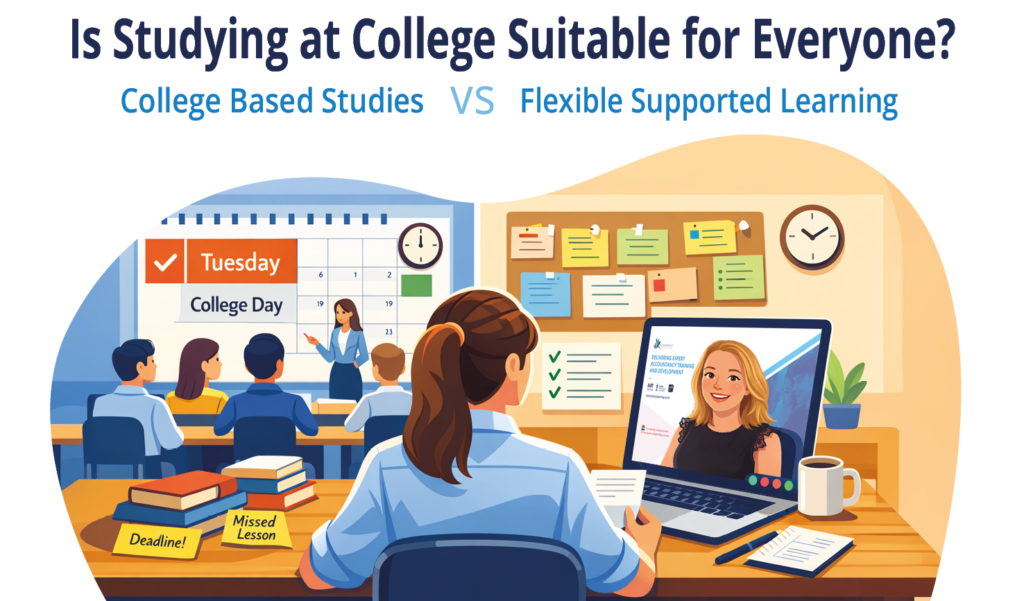
- Fixed Classes Don’t Always Fit Around Real Life
Let’s say your class is every Wednesday evening.
Fine in theory.
But what happens when:
- Work runs late?
- You’re tired after a long day?
- Childcare falls through?
- You’re unwell?
- Life simply gets in the way?
Miss one lesson and it can feel like you’ve missed a big chunk of the course.
And once you start feeling behind, it’s very easy to lose momentum.
That’s often where confidence takes a knock too.
You don’t just feel like you missed a class — you feel like everyone else has moved on without you.
A bit rude, really.
- Everyone Learns at a Different Pace
In a classroom, the tutor has to teach to the group.
That means the pace is usually somewhere in the middle.
Which sounds fair… until you’re the one it doesn’t suit.
You might find that:
- Some topics make sense straight away, and you’re ready to move on
- Other topics need more time, repetition, or practice
But a classroom can’t always flex around that.
So you either end up waiting for everyone else to catch up, or trying to keep up when you need more time.
Neither is especially helpful if your goal is to actually understand the subject, build confidence, and feel properly prepared for your AAT qualification.
- Travelling to College Adds Extra Pressure
This bit often gets overlooked.
Studying isn’t just about the lesson itself.
It’s also about:
- Getting there
- Getting home
- Rearranging your day around it
- Finding the energy for it in the first place
And if you’re balancing work, family, or other commitments, that extra layer can turn “manageable” into “absolutely not this week”.
The course itself may not be the issue.
It may simply be the way it’s delivered.
So… What’s the Alternative?
This is where distance learning can be a much better fit.
Not because it’s easier.
And definitely not because it’s some sort of “teach yourself and hope for the best” arrangement.
A good distance learning course still gives you structure and support.
It just removes a lot of the unnecessary rigidity that can make traditional study difficult.
Why Distance Learning Works Better for Many Learners
Distance learning gives you something college often can’t:
Flexibility without losing support.
And for many AAT students, that can make all the difference.
- You Can Study Around Your Life
Instead of trying to squeeze your life around a class timetable, you can study when it actually works for you.
That might be:
- In the evening
- During a quieter part of your week
- At weekends
- In smaller chunks rather than one long session
That flexibility can make studying feel far more realistic — and far more sustainable.
Because if your study plan only works in a perfect week, it’s not really a plan. It’s more of a fantasy.
- You Can Learn at the Right Pace
One of the biggest advantages of distance learning is that you can move through topics at a pace that suits you.
That means you can:
- Move more quickly through areas you find easier
- Spend longer on the topics that need more attention
- Revisit lessons when you need to
- Build confidence before moving on
That tends to lead to something quite useful:
actually understanding the material.
Which, conveniently, is rather helpful when exams appear.
- Missing One Study Session Doesn’t Mean Falling Behind
This is a big one.
If life gets in the way for a few days, you haven’t “missed the lesson”.
You haven’t been left behind by the class.
You can simply pick things back up and carry on.
That doesn’t mean procrastination suddenly becomes a personality strength.
But it does mean one difficult week doesn’t have to derail everything.
- You Can Still Get Tutor Support
A lot of people assume distance learning means being left to fend for yourself with a textbook and a vague sense of optimism.
It shouldn’t.
A strong distance learning course should still include proper support, such as:
- Experienced tutor guidance
- Help when you get stuck
- Marking and feedback
- Clear study plans
- Structured learning resources
So the support is still there.
You’re just not tied to a classroom every week to access it.
Is College Wrong, Then?
No — not at all.
For some learners, college is absolutely the right option.
If you know you work best in a classroom, benefit from in-person teaching, and can commit to a fixed weekly routine, it may suit you perfectly.
But that’s the point really:
study should fit the learner — not the other way around.
Because the best route isn’t the one that looks most traditional.
It’s the one you’re most likely to stick with, progress through, and complete successfully.
A Final Thought
If you’re thinking about starting an AAT or bookkeeping course, it’s worth asking yourself:
- Will this fit around my life realistically?
- Will I be able to stay consistent with it?
- Will it help me feel confident and prepared for exams?
Because the goal isn’t just to start studying.
It’s to keep going, stay on track, and actually finish the course feeling capable and confident.
And for a lot of learners, that’s exactly why distance learning works so well.
If college suits you — great.
If it doesn’t — that’s not a problem either.
There’s more than one way to become qualified.
And frankly, there should be.
If you’re exploring your options, take a look at our AAT courses to find a study route that works around your life.
We’re always happy to have a conversation about what might suit you best. Call us on 01392 435349 or email [email protected].